For generations, the backbone of a successful small business has been personal connection. Customers often return not just for a product, but for the familiarity of a friendly conversation and the trust built over years of repeated interaction. When a business has operated for decades, this established relationship is its most valuable asset. Today, many business owners wonder if introducing modern technology means sacrificing this deeply rooted personal touch. The reality is that technology, when applied thoughtfully, can support rather than supplant human connection. Integrating automated applications into a long-running small business is a thoughtful process, but owners can explore ways to do so while working to maintain personal service, institutional memory, and established customer relationships. The goal for many is to use automation to handle routine tasks, potentially freeing up experienced staff to engage in meaningful conversations. By carefully managing this transition, owners can seek a balance where longstanding methods thrive alongside new administrative efficiencies, offering a bridge between historical operations and modern convenience.

Preserving Institutional Memory Through Careful Documentation

When a business has operated for a long time, an immense amount of undocumented knowledge often resides solely in the minds of the owner and core staff. This institutional memory includes the subtle nuances of how a product is sourced or unwritten troubleshooting steps for older equipment. Introducing a chatbot typically involves codifying a fraction of this knowledge so the system can provide accurate answers to frequent inquiries. The process of documenting these frequent questions can be a valuable exercise in a reflection on old-fashioned values. It encourages a business to actively articulate the standard responses that have helped shape its reputation over the years. However, a chatbot is not meant to replace the nuanced understanding of a veteran employee. Instead, owners might choose to program the bot with clear, bounded answers to common questions, like operating hours, basic return policies, or directions to the store. This careful documentation can help preserve experienced staff time, potentially allowing them to apply their specialized knowledge to more complex customer needs that require a human perspective. As staff members document these processes, they also create a lasting record of the business’s operational philosophy, which can be useful for training new employees in the future.
Review the website before automating answers to repeated questions. If customers cannot find opening hours, service details or the next step, update that information first. When considering outside help, compare the on-page SEO review scope with the specific gaps you have documented. Page improvements and chatbot setup are separate tasks: ask which headings, descriptions and navigation issues a review covers, and keep human review of the answers as part of the workflow.
Choosing the Right Technology for Your Operations
Selecting the appropriate system is a step that benefits from an honest understanding of what the business actually needs. There is rarely a one-size-fits-all solution, and a local hardware store will have different communication requirements than a bakery. It can be helpful for decision-makers to evaluate the various chatbot app options for different business needs to find a platform that aligns with their specific operational tempo. A straightforward rule-based bot that offers a limited menu of clickable options might be more appropriate for a classic restaurant than a complex generative AI system that attempts open-ended conversations. The focus often remains on utility and ease of use, rather than simply adopting the latest technological trend. By prioritizing practical functionality, the business can work to ensure that the new tool serves the customer effectively, offering clear answers to simple questions without overwhelming the user with unnecessary complexity.
Evaluating Automation with a Structured Approach
The introduction of automated communication into a traditional setting is often handled with restraint. Attempting to automate too much of the customer journey can sometimes lead to frustration among loyal patrons who are accustomed to personal service. To navigate this, businesses might adopt a structured, conservative approach to risk when implementing new software. The National Institute of Standards and Technology provides an optional structured risk-review framework that encourages a govern, map, measure, and manage approach. Applying this methodology to a small business might involve governing what topics the bot addresses, mapping out the specific customer journeys where automation is helpful, measuring the outcomes of these interactions, and managing the system over time. By focusing automation on predictable, low-stakes interactions, the business can protect its core strength: the personal, human interactions that characterize its longstanding service model. Owners researching bounded automation can use these real-estate chatbot examples to compare routine-question handling with the human review and personal service that long-running businesses still need. This site and Messenger Bot share common ownership; links to Messenger Bot are related resources, not independent endorsements.
Transparency, Disclosure, and Managing Expectations
Honesty has long been a cornerstone of traditional business practices. When a customer interacts with automated software, providing clear disclosure that they are interacting with a machine is a helpful practice. Attempting to present a chatbot as a human employee can create confusion and frustration for long-time patrons who value authenticity. Providing a clear disclosure helps manage expectations from the outset. Businesses might consider beginning automated sessions with a straightforward greeting that identifies the bot. Furthermore, businesses should be careful not to overstate what the technology can do. The FTC’s advertising and marketing guidance supports using evidence for claims. If the bot is designed to answer only specific logistical questions, it is helpful to make that clear right away. This transparency can be related to an article about preserving business legacy before a sale, as it helps maintain a culture of honesty that can benefit the entire operation and uphold the reputation the business has built over decades.
Privacy and Data Minimization Practices
Long-running businesses often earn their customers’ trust by treating personal information thoughtfully. A loyal customer might have had a standing order for twenty years, trusting the shopkeeper with their preferences and contact details. When implementing a modern chatbot, similar data practices can be considered. The Federal Trade Commission provides guidance on limiting and protecting collected information. Businesses can choose to configure chatbots to ask only for necessary data. If a basic question can be answered without collecting an email address or phone number, owners have the choice to design the interaction so it skips asking for that information. Any data that is collected should be secured, applying modern digital practices to keep the equivalent of the old shopkeeper’s ledger safe from unauthorized access. This approach respects the long-standing trust that the business has cultivated within its community.
Exploring the Staff Handoff
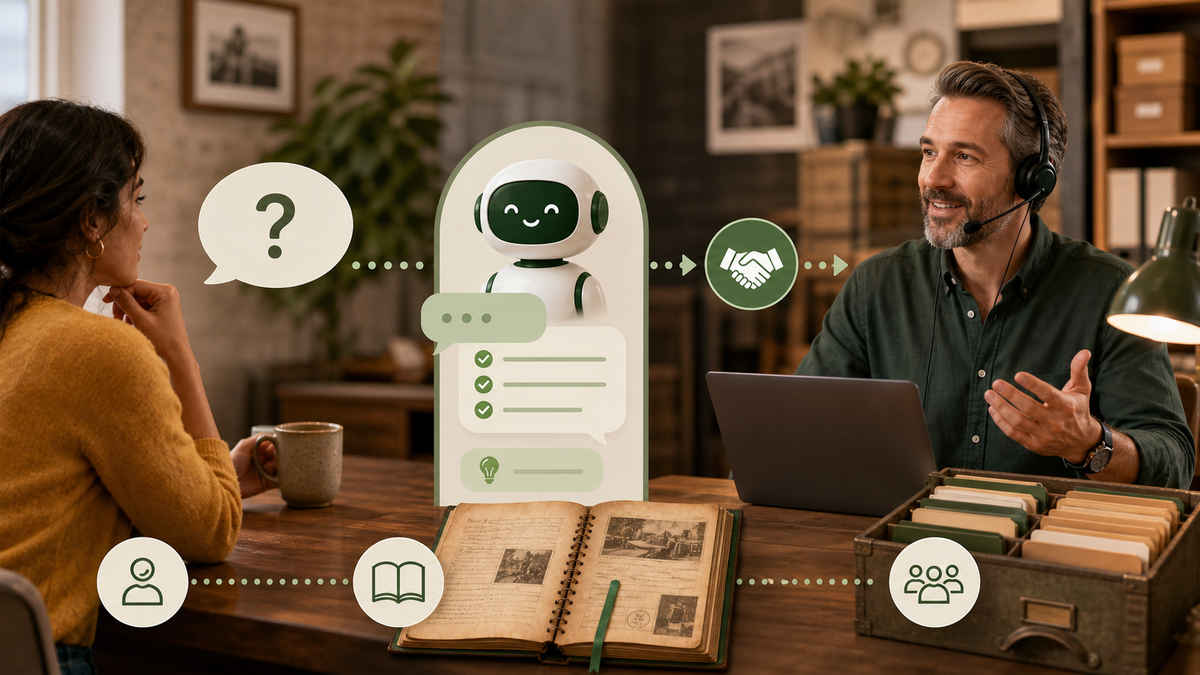
As automated systems encounter complex questions or nuanced situations, owners may choose to explore ways for customers to transition from the bot to a human staff member. The official Meta Business Suite Inbox overview describes how supported Meta-channel messages can be managed together. Businesses should separately test their own handoff process and whether a chosen product lets staff review earlier messages. Finding a comfortable balance between automation and personal interaction can align with the themes found in a family heritage and values article, highlighting the importance of attentive, personal care in a commercial setting.
Testing and Refining the Human Tone
Before making a chatbot available to the general public, businesses might consider internal testing to see if the automated responses align with their historical voice. If a local shop is known for warm, neighborly greetings, a bot that responds with overly sterile efficiency could feel out of place. Staff members can spend time interacting with the bot in a test environment, adjusting its scripts to try and capture a sense of the company’s personality. This effort can be balanced with disclosure, allowing the bot to sound friendly and welcoming while still identifying as an automated tool. Ongoing refinement allows the business to iteratively improve the bot’s tone based on observations and feedback, treating it as an evolving tool rather than a finished product.
Understanding the Limitations of Chatbot Implementations
It is helpful for owners and managers to recognize the limitations of automated software. Chatbots generally do not possess human empathy or the ability to intuitively read between the lines of a complex or emotional situation. They are often less capable of the spontaneous problem-solving or creative accommodations that define personalized customer service. Businesses can choose to view these tools as administrative aides designed to handle routine inquiries, rather than full replacements for human interaction. By understanding these boundaries, owners can set realistic expectations for what the technology can achieve and where human intervention remains most valuable.
Practical Decision Checklist for Implementation
Before committing to an automated messaging system, business owners might review this practical decision checklist to guide their planning process:
- Identify repetitive questions that frequently consume staff time.
- Determine if a traditional FAQ page on the website could address the problem effectively.
- Explore software options to see if they offer the capability for a human operator handoff.
- Draft a disclosure statement introducing the bot as automated software.
- Review the software provider’s data collection policies regarding data minimization practices.
- Consider assigning a staff member to periodically review the bot’s conversation logs for common user issues.
- Test automated responses for clarity and alignment with the brand’s tone.
- Consider establishing a flexible protocol for when staff might need to intervene in automated chats.
Conclusion
Integrating automated communication tools into a business with a long history is often about finding ways to support the future viability of the enterprise while respecting its past. By documenting frequent questions, applying automation to routine tasks, considering privacy practices, and exploring handoff capabilities, an established enterprise can seek the efficiencies of a chatbot while maintaining its core character. The personal service, institutional memory, and established customer relationships can continue to be central to the business. They can simply be supported by technology that operates in the background, providing administrative assistance and allowing staff to focus on the human interactions that define the business.
Frequently Asked Questions
Will adding a chatbot make my longstanding business seem impersonal?
It depends on how it is implemented. The goal of many chatbots is to handle routine questions so that experienced staff might have more time to provide personal service when customers need human assistance. If the bot is transparent about its nature and the business provides ways to reach a person, it can support rather than diminish the personal touch.
How can we try to make the bot sound like our brand?
Businesses can actively write and review the bot’s scripts before it goes live. Involving experienced staff in a testing phase can help ensure the language reflects the company’s traditional tone. While it should identify itself as an automated system, the phrasing can still aim to be polite and aligned with the vocabulary the business uses.
What might we do if the chatbot gives a customer confusing information?
Correction by a human staff member is often a helpful approach. This is why periodic monitoring of chat logs can be useful. If a mistake is noticed, a staff member might reach out to the customer to clarify the information. Subsequently, the bot’s programming could be reviewed and updated to try and prevent similar confusion.
Can chatbots impact how we handle customer data?
Yes, which is why considering data minimization is often a helpful step. Businesses can configure systems to avoid asking for personal information unless it helps answer the specific query. Owners can review data practices to focus on collecting and retaining only the information that serves a clear business purpose.
Can automated tools help organize our standard answers?
Yes, the process of programming a chatbot often requires a business to clearly define its standard answers to common questions. This exercise can help organize institutional knowledge and create a useful reference guide for both the automated system and new human employees.

0 Comments